Highland Titles has from the first day of trading made sure that we comply with the law in all regards. My wife is a barrister and latterly in her career at the bar, a senior Crown Prosecutor. Before we commenced selling our square feet, we consulted our family solicitor in Aberfeldy. When he retired, our new solicitor in Pitlochry confirmed that we fully complied with Scots law and provided us with a general letter to confirm that this was the case because some agents and vendors required written confirmation.
In 2012 a new Land Registration act was passed, prompting the Registers of Scotland to confirm that with the passing of the Register of Sasines, no legal avenue remained for recording the sale of souvenir plots. We revised our advice accordingly, to make clearer that a souvenir plot purchased from Highland Titles could not be registered unless the law changed.
In 2015, we received considerable free advice from lawyers and academics, active on Twitter. Some helpful and some mischievous (but all good publicity). Our Guernsey solicitors, advised us to seek counsel’s opinion on the scant Registrar’s advice – which took the form of a definitive written advice from an eminent Scots QC. The advice confirmed what our Scottish solicitors had previously advised, but with a considerably larger price tag!
We also took advantage of the Advertising Standards Authority’s Copy Advice Team‘s review service. They reviewed our non-broadcast advertising (our web site) and confirmed that we complied fully with their CAP code.
Then, onto the playing field came Jill Robbie and Malcolm Combe, academics from the University of Glasgow and Aberdeen respectively. They had kindly taken time out to study our business model and clearly saw the inherent problems caused by the Registers of Scotland’s lack of capacity to deal with the sale of souvenir plots. In their paper, published in the Edinburgh Law Review, they begin:
After setting out the problems caused by the lack of capacity in the Registers of Scotland (which I see more as an opportunity – our customers generally have no wish to pay the Scottish Government to register their plots when they are registered by Highland Titles for free) they go on to put the case for reform, commencing with the question “The online debate encourages reflection on whether there is continuing justification for the prohibition on registration of souvenir plots.“
They point out the problem caused by the ongoing lack of resources at the Registers of Scotland, a position which they suggest will not change at least in the next ten years. They write that an argument against registering small plots is that once land has been broken up into small units in multiple ownership, resale becomes difficult. They argue that the “sterilisation of land should not be encouraged”. However I believe that putting parcels of land beyond development has great value when it comes to conservation land.
Finally they argue that the lack of a real right to an asset of low economic value such as a £30 souvenir plot might not be of significant concern, and this really is the nub of the issue. The Scottish government, either deliberately or accidentally, has enabled Highland Titles to sell souvenir plots of land without any requirement – indeed without the option – of paying to locate these plots on the Scottish cadastral map, with all the associated costs that would obtain.
Thank you Jill Robbie and Malcolm Combe for your kind review of the law surrounding Highland Titles and souvenir plot sales in general. Should you like to have a free square foot for your troubles, please let me know.
In Internet slang, a troll (/ˈtroʊl/, /ˈtrɒl/) is a person who sows discord on the Internet by starting arguments or upsetting people, by posting inflammatory,extraneous, or off-topic messages in an online community (such as a newsgroup, forum, chat room, or blog) with the intent of provoking readers into an emotional response or of otherwise disrupting normal, on-topic discussion, often for the troll’s amusement. (Wikipedia)
Over the years, Highland Titles has grown from humble beginnings to become the solid conservation movement that it is today, some 11 years after the first plot was sold. Whilst thousands of people have joined our cause and our way of raising funds, a handful of people have been attracted to me and Highland Titles simply in order to troll us. Most large and successful organisations and people attract a few trolls, so it is hard to be too upset. We do our best to wear it as a badge of honour because it marks us out as having become the market leader in private conservation. But it is interesting to understand the people who do it.
Psychologists categorise trolls as narcissistic, psychopathic sadists. Trolls will lie, exaggerate, and offend in the hope of getting a response and in the hope of inflicting pain. The damage that they cause is all part of their gratification. Research in communication and psychology has investigated people’s perceptions, rationale, and behavior and identified several factors that determine the likelihood that a given individual may post offensive content.
These are some of the most common:
1. Anonymity: Some people relish the anonymous nature of the internet. Sites such as Twitter, the comment sections of media sites, and even Facebook, permit people to use a screen name that bears no relation to their actual identity. This anonymity emboldens people and may encourage more deviant behavior, because their anonymity enables them to avoid any consequences.
Even when people use an account tied to their real identity and know they are not anonymous, they may still be emboldened by feelings of obscurity. They may believe that their actions are still fairly private. If Robin is commenting in a small Facebook group, for example, even though the comments are tied to his real name, he thinks that the people who matter in his life won’t read the post and the people who do read his comments are probably mainly people in other countries and will never encounter him in the real world.
2. In the majority: When people think they are in the majority, they will more freely express their opinion than when they see themselves as in the minority. Thus, although individuals may not make untrue or offensive comments offline, they may feel able to do so in an online setting because they think their opinion is the prevalent one there.
3. Amongst “friends”: On sites like Facebook and Twitter, people may perceive their online environment to be full of people like them, because they are part of the same social network. Thus, individuals feel confident self-expressing because they anticipate support or agreement from their network. Amanda might post an angry, vitriolic message because she assumes that her network members feel the same way. She might even do so to earn “likes” or other expressions of agreement from her friends. But social media networks are often more heterogeneous than we think. Even private posts may reach “friends of friends”— people we may not even know. And comments can easily be shared outside of our immediate network. Thus, although we feel we are surrounded by people who agree with us, there actually may be many who disagree or find our comments hurtful and in some cases may leave a troll open to legal consequences, either for defamation or under the criminal law. Harassment is taken very seriously by law enforcement.
4. Desensitisation: Over time, we may get desensitised to the internet. Whereas once we would have thought about the legal consequences of what we wrote or said, when we are online we just post without thinking about it. We may see so many nasty comments that we think making one ourselves is risk free. If we get used to using a certain social media site like Facebook or Twitter to express our daily experiences and frustrations, we start to lose our filter. It is also easier to type something defamatory into a screen than to say it to someone’s face.
5. Personality: Some individuals, such as politicians, are outspoken by nature. They may tend to think that they are morally superior to others. Or they may just enjoy making other people uncomfortable or angry. Any of these traits may drive individuals to express themselves online without a filter. Personality traits such as self-righteousness and social dominance orientation (in which you think some social or ethnic groups, typically yours, are inherently better than others) are related to expressing intolerance. Others are “hard core” believers who will express their opinions no matter what, because they believe their opinion is infallible.
6. No consequences:Social exchange theory suggests that we analyse the costs and benefits in our communication and relationships. Generally we believe that the benefits of expressing oneself outweigh the costs. If we can remain anonymous, we believe we won’t be held personally responsible. Perceived majority status, social identity salience, or being surrounded by friends means you believe that even if some people are upset or angry, you have more (or more important) people on your side, so you win more friends than you lose. Personality traits and desensitisation may make offending or losing friends not seem like a real consequence, because those friends aren’t really “worth it” if they can’t handle the “truth,” or they aren’t really friends if they don’t agree with or tolerate you.
7. Social identity salience: The social identity model of deindividuation effects, commonly referred to as the SIDE model, suggests that when online our social identity can mean more than our individual identity. Andy might be a nice, civil person offline, but when he goes online to talk about Highland Titles, he may feel free to express outrageous, untrue and defamatory sentiments, oblivious to the damage this may cause and his own exposure to the cost of legal action. This is also often seen in political discussions, in which people start responding like a group member based on political, national, ethnic, religious, or other identity or affiliation. This process of deindividuation is known in more extreme forms as “group mentality”— you stop seeing yourself as an individual and act in line with the group. As a result, the group’s behavior becomes increasingly extreme as individual members of the group shift to conform to the group even if their opinions were not originally as extreme as others in it.
That still leaves the question “Why do trolls do it?”. Just because somebody has a personality that leaves them open to temptation, it is still a personal decision to try and hurt somebody.
Trolls are bored. Being failures in their own lives, they seek attention online where it’s readily available and easily acquired. A troll’s behavior reflects their insecurity. If someone responds to their words it adds meaning to their lives. They crave attention: All a troll wants is you to turn the spotlight onto themselves. They want you to repost their comment to your followers. They want you to write a blog post or status about them. They will use anything and everything to get it and if the truth is pedestrian, they will make up more interesting “fake news” to gain attention.
Victims often feel compelled to respond to “set things right.” However, even if you respond in a cheerful or positive way, providing accurate information, you’re still feeding the troll and the whole enterprise escalates.
The frontrunner to become President Donald Trump’s ambassador to the European Union claims to be a laird – a claim quickly denied by Lord Lyon.
As I stated in an earlier post, Lord Lyon simply sells coats of arms – at a price designed to be unaffordable for “ordinary people”. He cannot create lairds – he does not sell land. It appears that Ted simply bought an overpriced coat of arms that he could have bought for less elsewhere.
Lairds are landowners and Ted would have been better advised to save the thousands of pounds he squandered on Lord Lyon and invested £30 with Highland Titles. A hard lesson to learn Mr Malloch.
Well 2016 is almost over and what a wonderful year it has been. The nature reserves have never been busier. Sustrans appear to have finally decided that, yes, they do want to bring their path over Keil Hill (that took them ten wasted years), the wild brown trout in the lochan have attracted an osprey as well as otters and heron. We have seen many more red squirrels and other mammals. David has now received his training (thanks to Trees for Life) on how to set up and develop our new tree nursery.
Our support of Wildcat Haven has been very valuable to the future of the Scottish wildcat. I must not steal their thunder and will leave them to announce their great news, but suffice it to say that they have fantastic plans which they will announce in the next couple of weeks. I have supported Wildcat Haven for several years and before that the passionate Mr Steve Piper who ran the Scottish Wildcat Association. Every penny that we have given has been well spent. Hopefully the other “trap ’em and display ’em” wildcat group will fade away.
Our supporters only ever meet our front-line staff, our wardens or our customer support team. However there is a secret army of elves, who actually pack the orders we ship – and behind them is the finance department and sales and marketing. They are unsung heroes, but this is their busiest time of the year. As I type this, on Friday afternoon, only customer support remains at work and the phones have now gone quiet.
So, to everyone who has supported us, at any time in our ten years of operation, I say THANK YOU. I am proud to have been able to help to “conserve the Scottish Highlands, one square foot at a time”
As government cuts make running extracurricular activities more challenging for our local schools, Highland Titles are delighted to once again donate a cycle to Ballachulish Primary School as the main raffle prize for their Christmas Fundraising again this year. Hopefully the lucky winner will be able to use it to cycle along our tracks at Keil Hill.
Years ago, it was rare to hear about a child with type 2 diabetes. Doctors used to think children only got type 1. It was even called juvenile diabetes for a long time. But not any more. Exercise – or lack of it – is probably the main reason for the rise in this pernicious disease. Getting out on the hill and cycling are two excellent ways for youngsters to avoid Diabetes.
Type 2 diabetes runs through my family. My mother, both her parents and my sister have suffered from Type 2 diabetes. However, I have so far escaped, probably due to a lifetime of waking in the hills and a vegan diet. But I could certainly lose a few pounds and now lead a depressingly sedentary lifestyle, running Highland Titles. How I envy our volunteers who get rained on every day and are the figures of fitness, on their feet all day leading tours and planting trees. Perhaps we should swap jobs now and then!
I spent many years in medical research dealing with the systems that, when they do not work correctly, lead to diabetes. Your digestive system breaks down carbohydrates like pasta and potatoes into a type of sugar called glucose. Your pancreas creates insulin, a hormone that moves glucose from your blood into your cells, where it’s stored until it is used as fuel.
In type 2 childhood diabetes, the insulin receptors on cells in your child’s body fails to respond to the insulin, and glucose builds up in the bloodstream. This is called insulin resistance. Eventually, the sugar levels in the blood get too high for it to handle. That hyperglycaemia can lead to other conditions in the future, like heart disease, blindness, and kidney failure. Progress to these complications is particularly rapid in children.
Type 2 diabetes is most likely to affect girls rather than boys who are overweight. In the UK and USA nearly 1 every 3 children is overweight. Once a child gets too heavy, they are at a much greater risk to develop diabetes. Children become obese because of a lack of physical activity and eating to much of the wrong sorts of food. The school run is certainly one factor. In my day, we all walked to and from school every day. Children now expect to be driven everywhere. The development of safe cycle routes and footpaths is a large part in reversing this trend.
So, what are the symptoms?
At first, there may be no symptoms. Over time, you may notice:
Unexplained weight loss
Hungry or thirsty a lot, even after eating
Dry mouth
Peeing a lot
Fatigue
Blurred vision
Heavy breathing
Slow healing of sores or cuts
Itchy skin
Numbness or tingling in the hands or feet
Take your child to the doctor if you notice any of these symptoms. Better still, encourage them to maintain a healthy weight by eating the right food and exercising enough. Failure to do do should not be an option.
Highland Titles wants to encourage everyone to discover the great outdoors. Not only do we want to create spaces that provide places for wildlife to live, we also want to help people get out and experience the great outdoors for themselves. I spent my life walking and cycling and I want to encourage others to do the same. Creating a love for the countryside will ensure that people want to care for and protect the countryside. It’s a win win.
Sustrans is a charity that enables people to travel by foot, bike or public transport for more of the journeys we make every day. Their aims are aligned with ours and I am a long term Sustrans supporter. In 2007, Sustrans approached Highland Titles to seek permission to bring part of their new National Route 78 through our land at Duror. The Caledonia Way is a 237 mile path which runs from Campbeltown to Inverness – following Kintyre and the Great Glen, iconic features on any map of Scotland. It offers a variety of cycling, from challenging on-road hills to lengthy sections of traffic-free path through the spectacular scenery of the west coast of Scotland. We were keen to get involved.
Years passed and whilst the rest of the route took shape, the short section south or Duror remained incomplete, in part because of local politics and difficulties in reaching agreement about the best route. Should it come over Keil Hill, with its 60 metres of climb, or should it find a flatter alternative. Much of this route follows the course of an old dismantled railway line,with its flat gradients. Unfortunately in places ownership of the line had become complicated and uncertain.
I felt that a small detour through our magnificent nature reserve would be welcomed by most walkers and cyclists, so in 2009 we began to build the cycle-track ourselves.
This was not as altruistic as it might sound, because we were getting a rising number of visitors as we began to sell plots. Our visitors needed proper tracks to find their land and explore the beauty of Keil Hill. What we soon found was that building a track over Keil Hill was no simple matter.
We entrusted the job to long-time friend and Digger expert, Stanley Cameron from Spean Bridge. If anyone could find a route it was Stanley. After a month of careful work, during which he came close to sinking with his digger in the bottomless peat bogs, the route was finished. It then had to dry out for a year before we could be certain of success.
A review of the track in 2010 found that much of it was still soft. This was because the track was supplied with water from below from a multitude of springs. Stanley recommended reinforcing the clay of the track with crushed rock and then adding a six inch topping of crushed rock. Fortunately we were able to create a few quarries close to the track which now provides several useful new habitat sites. Stanley and his digger returned to Keil Hill for a few weeks and with the additional support of rock crushing machinery and a big tracked dumper truck to move the rock along the track, we made some considerable improvement to the track. Time to leave it for another year to consolidate and dry out some more.
After another six months, we could see that the the track was shaping up, so we brought Stanley back in the summer of 2011 for another session quarrying rock and topping off the track. This was becoming an annual event!
But the result was excellent as you can see in the photographs below, taken in May 2013. Not yet fit for road bikes, but an excellent walking track, capable of safely taking the estate vehicles and perfect for horses (no, we have not had any horse-riders yet, but they would be welcome to visit). Visitor numbers were doubling every year and by 2013 we had recruited local volunteers to help with the needs of visitors. In December 2013 I had the pleasure of taking local resident Jimmy Cormack to view the Nature Reserve for the first time. Jimmy asked whether we had plans to improve the track to be suitable for disabled access and I assured him that the plan was to add a surface suitable for wheelchairs and mobility scooters. Unfortunately this depended entirely on the local roads department resurfacing a road somewhere close, because we planned to purchase the tarry road planings, which form a perfect road surface. This could be this year or in several years, I could not know which. This lead to our purchase of a John Deere Gator which has proved to be not only a vital means of providing access to visitors with disabilities, but it has also been a hit with everyone else.
The year slipped by and became 2014. We put out feelers with everyone who might hear about resurfacing work, but it was quiet. As you can see in the photographs below, taken in May 2014, the tracks were very solid, but not yet a cycle track!
Then we got the call, and in early 2015 we took delivery of 2,000 tons of road planings, which we had the tedious job of moving in 6 ton loads, as no larger vehicle could safely navigate the track. Our local machine man, Hamish, with help from volunteers, got to work spreading the planings along the track and by the summer of 2015 we had a cycle track, six years after the first roughing out work! It is impossible to say how much faster Sustrans could have achieved the track, but I think they would have had the same problems with water and would, like us, have needed to allow years for the base to dry out and consolidate. We may yet get to find out, but I am getting ahead of myself. Below are photographs taken in 2015 which show the new, surfaced track, in use.
As an aside, we had been working on several other trails, most of which were simple footpaths. Footpaths have two advantages. They permit access to the parts of the reserve which are particularly lovely and they temd to discourage visitors from roaming too freely and disturbing the animals and plants that call Keil Hill their home. Striking a balance between a Nature Reserve, which is best left undisturbed, and amenity land, which is designed to be visited, is a balance which we take very seriously. Over 10,000 visitors a year require some careful thought if they are not to damage the very thing they come to see!
One trail that gets a lot of use is the “Loch View Trail”, which provides magnificent views of Loch Linnhe and access to areas which we are clearing of bracken with our pigs. With its topping of planings, this track is also ready for cyclists.
Which brings me back to the subject of National Route 78. Once we had topped our tracks and built a small bridge over the outlet stream from the old lochan, we were “bike ready”. Unfortunately a few hundred metres of the track down to the old graveyard does not belong to us and so it had not been improved, but this is a very solid track and even if cyclists dismounted for this part the route was still a safe alternative to the main road. Time to contact Sustrans and see if they wanted to advertise it. But before we got around to it, Sustrans contacted us.
In January 2016, Transport Planning and Engineering (TP&E), working with Sustrans, emailed me in the following terms
“TP&E on behalf of Sustrans are progressing a review of the NCN 78 which currently uses the A828 south of Duror. In an open and transparent process we wish to meet the landowners prior to engaging with the communities about the options available to deliver an off road route. We are aware of the history and constraints of this route hence an off road route has not been delivered to date. I must stress we are contacting landowners first prior to the communities due to the known sensitivities of the route. “
This approach lead to Sustrans and Highland Titles, amongst others, joining the Duror community council meeting in March 2016 to discuss the two route options (Footway (A828) or Remote Footpath (Keil Hill)). Members of the Council were unanimous that completion of the cycle track should be expedited but no decision was taken as to which route was preferred.
Over the following months, Sustrans looked carefully at the alternative route to Keil Hill, which would be to run alongside the east side of the A828. They dismissed this option because of the the traffic risks to cyclists and others in following the level route within inches of fast-moving traffic on this busy trunk road. The east side of the road at this point is overshadowed by a steep rock-face, which would need to be cut back for a considerable distance to allow for the construction of a path of even the minimum width. Compared to the small (60 metre) climb to traverse Keil Hill, with its views and beauty, Sustrans preferred the Keil Hill route. However, they did not propose to use the track which we built, preferring another route over Keil Hill, which approached via an existing forestry track, but then proceeded across slightly lower ground with less steep gradients. This, they felt, would make the passage over the hill less strenuous for users. The traverse of the Highland Titles Nature Reserve, with its ponds, bird-life and upland scenic location would make this an attractive alternative to ‘going alongside the Main Road’.
Sustrans have now sent us their final report and we wait with interest to see where the cycle track journey takes us. I feel it would be a shame if Sustrans decides to go to the expense of building a second track which I feel has no particular benefits over the track we have already built. But, if this is the only way to take vulnerable cyclists off the busy and dangerous main road, then I certainly don’t object. What it tends to prove is that public funds are often wasted. But then I already knew that. Cyclists are very welcome to use our cycle track, but without publicity and signage, few will even realise that it exists.
Some people are unclear about whether Highland Titles Ltd is a charity and the simple answer is that it is not a charity. It is a simple for profit limited company, (Registered Company Number 1599) registered in the country where I live (Alderney), with one share – which is owned by the Guernsey registered charity, The Highland Titles Charitable Trust for Scotland (Registered Charity Number CH444).
We are set up, therefore, in much the same way as the National Trust for Scotland (Registered Charity Number SC007410), which wholly owns a for profit trading company, called National Trust for Scotland Enterprises Ltd (Registered Company Number SCO95585). The National Trust for Scotland Enterprises Ltd is not a charity, but as it is owned and controlled by the National Trust, it behaves much like one. The Company trades for the benefit of its shareholder – the National Trust for Scotland, and Highland Titles Ltd trades for the benefit of its shareholder The Highland Titles Charitable Trust for Scotland.
This arrangement of a Charity owning a trading company is one recommended by The Charity Commission and HM Revenue & Customs. They recommend that where a charity relies on trading (rather than or in addition to donations), then they should create such a subsidiary trading Company. Highland Titles starts from the premise that there are enough small charities milking donors for funds and so we have chosen not to simply hold out a begging bowl hopefully. We offer a product that is popular and profitable through a subsidiary trading company. Those profits are all ploughed back into Scottish conservation.
Google has been a great help with our project in many ways. They have enabled us to reach out to the world for support; most of our visitors come through a Google search. But perhaps the most helpful service that Google offer, and a free service too, is the Google map. Google maps have meant that we are able to provide all our customers with a link to their plot, so that they can view where it is.Quite a lot can be seen from the road. In 2014 Google added a
A few years ago Google launched Google Streetview with Scottish data and users could drive past the nature reserve; there is almost a mile of the A828 road which runs alongside the Duror Nature reserve. The A87 runs through the middle of the Reserve at Mountainview, home to Wildcat Haven and Bumblebee Haven. tour of the Duror Nature Reserve. Unfortunately they did not feature all the tracks – there are many miles of these – and the pictures are now more than two years out of date. But it still provides an opportunity for lairds who have no expectation of ever visiting to see what they own.
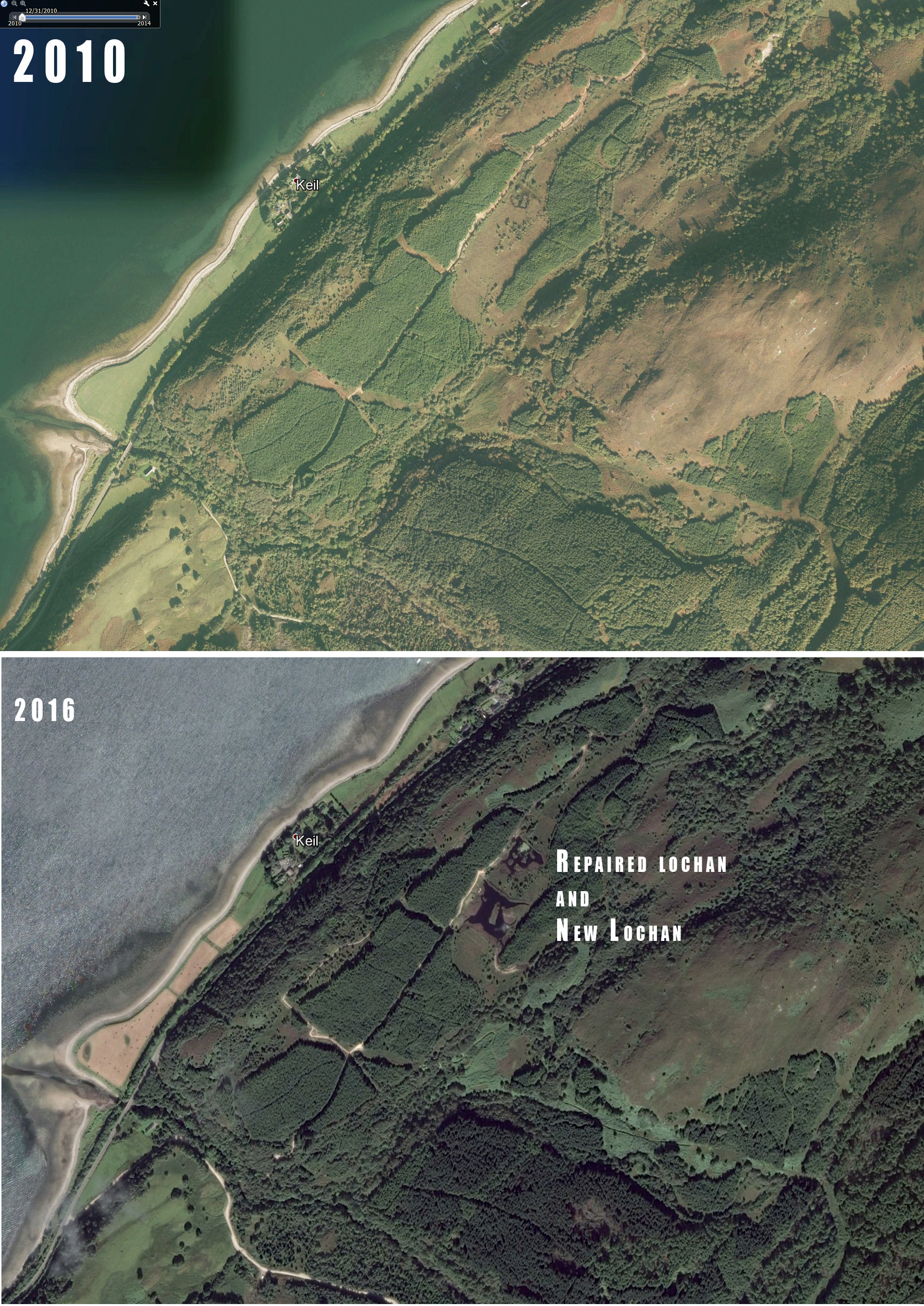
This year we have begun our own digital mapping of the reserves, using drones, so that customers will have access to higher resolution photography. Google too, have updated their mapping, releasing a new series of maps of the area that show features absent from the old maps. The repaired old lochan and the new lochan, the new tracks, the bracken free areas created by our pigs, the wildlife viewing hides and several other features that might be visible only to those who have known Keil Hill over several years. Missing, unfortunately, are the areas of cleared Sitka and the work we have done to boost the number of habitat boxes and benches is not visible of course.
To take a closer look at the Nature Reserve at Duror, please click on the Streetview logo for a tour, or the map on the right to compare the old map with the new map. Or just explore Google Maps below.
When I started Highland Titles in 2006, it was with a view to fund the planting of Scottish trees in Scotland. Years of government grants have expanded the number of exotic trees at the expense of native trees. Unfortunately most softwoods, planted at the densities desired by commercial forestry, provide nothing of value to any other animals or plants. A Sitka plantation is a sterile desert as far as Scottish wildlife is concerned.
But what to plant and where? The first question that we faced was what trees to plant and by that I mean not just what species, but where did the seeds come from?
It is important to use local stock for planting native species. Genetic adaptation to environmental factors has developed over time making it important to plant trees grown from locally sourced seeds. Even more important is to avoid imported trees, which are often available at a discount, but which can bring into the region pests and diseases that have no resistance in the local tree stock. An example of this is Ash Dieback – also known as Chalara dieback of ash. This is a disease of ash trees caused by a fungus called Hymenoscyphus fraxineus. (The fungus was previously called Chalara fraxinea, hence the name of the disease.
Since we planted our first trees in 2007, we have relied upon the professionalism of a local tree nursery, Taynuilt Trees. They are a small family-run nursery in Taynuilt, Argyll just a few miles from our Duror nature reserve. Taynuilt Trees specialise in tree species native to North Argyll. All their stock is traditionally grown in the open ground from seed they collect ourselves in the surrounding woods using a traditional rotational growing system. We will doubtless continue to make use of Taynuilt Trees, but this year we plan to create our own tree nursery to supplement Taynuilt stock – using seeds collected in our own woods at Duror and where we can get permission, surrounding native woods. We plan to collect seeds from at least 20-30 well dispersed parent trees.
Here at Highland Titles, weekend leave has been cancelled. We came into the office on Wednesday morning to find twice as many orders as usual; unusually these extra orders were mainly from the UK. Odd. August is usually a quiet month. We encourage staff to take their main holiday in August. Yesterday sales continued to be up and this morning again, we have a bumper bundle of orders. We have no advertising starting this week, no special offers, no affiliates advertising us.
The penny dropped when we compared the start time with the publication of a blog which was far from complimentary about us. We had to smile. The blog was being advertised far and wide by social media, to a new and untapped market. A percentage of all advertising converts to sales. We love all publicity, good or bad and we seem to be getting better at persuading people to get the message out there. A Highland Titles pack makes a great gift, even if sent tongue in cheek.
The main barrier to sales of souvenir plots of land is simply that most people have no idea that they can purchase a tiny bit of land, for themselves or as a gift. When they discover this simple fact many people simply file the information away. Some rabid nationalists may be outraged that foreigners are able to buy a bit of “their” country. Others are offended by the idea of private enterprise doing things that they believe should be in the public arena. Some love the idea of gifting land, supporting conservation, becoming part of a community. But the odd thing is that any and all of these people are potential customers. When we track where our sales come from, we get sales from hate-sites as well as from sites that love what we do.
At the end of the day, we are pleased to make a sale to anyone, whether they love us or loath us. Nature does not care.


 After setting out the problems caused by the lack of capacity in the Registers of Scotland (which I see more as an opportunity – our customers generally have no wish to pay the Scottish Government to register their plots when they are registered by Highland Titles for free) they go on to put the case for reform, commencing with the question “The online debate encourages reflection on whether there is continuing justification for the prohibition on registration of souvenir plots.“
 Psychologists categorise trolls as narcissistic, psychopathic sadists.